Understanding and Adopting a Systems Approach to DevRel
Every year, we are introduced to new tools that aim to ease developer experience. Tools that handle deploying in seconds, monitoring in real-time, and automating our automation. For many in Developer Relations, the job has become a race to master these tools: to be the person who knows the most flags in a CLI or the most obscure hooks in a library.
But here’s the uncomfortable truth: Tools are ephemeral. Systems are eternal.
In DevRel, knowing a tool, means you can show a developer how to get from point A to point B. It’s transactional. But understanding the system, means knowing why the developer is on the path in the first place, how their organizational politics influence their tech stack, and where the hidden friction points lie between their code and their business goals.
As AI continues to automate surface-level tasks, the differentiator for an experienced DevRel is not who knows the most tools, but who understands the system in which these tools exist. To truly advocate for a community, you have to stop acting like product demonstrators and start acting like systems thinkers.
In this article, we will explore:
- The difference between knowing, understanding, and executing DevRel systems
- The importance of systems thinking in developer relations
- How to move from tool-based expertise to system-driven impact
- Practical ways to apply systems thinking across the developer journey
The Toolbox Mindset
Most DevRel careers begin with tools. You learn a framework, an SDK, or a platform really well. Maybe you become the go-to person for debugging issues or building demos. You write tutorials, speak at meetups, and help developers understand how to use the product.
At this stage, your value often comes from practical knowledge. You know things like:
- How to integrate the SDK
- How to configure a deployment
- Which CLI commands solve a specific issue
- How to reproduce bugs and troubleshoot them
This kind of expertise is extremely valuable. It helps developers move from curiosity to a successful first trial. But there's a limitation. Tools change constantly. A framework that is popular today might be irrelevant in three years. APIs evolve. Infrastructure patterns shift. Entire development paradigms appear and disappear.
Take for instance how agentic AI and cloud systems are shifting development workflows today. If your expertise is built only on tools, you are likely to become very good at explaining how something works — but not necessarily why developers struggle with it, how the entire ecosystem interacts with it, or how you can help.
And that's where systems thinking comes in.
What Is Systems Thinking?
Systems thinking is a leadership approach that views an organization and its community as part of a broader, interconnected ecosystem. It provides a different lens — one that allows us to grasp the bigger picture, see the interconnections, and better anticipate the intended outcome.
For DevRel, this means shifting focus from single events or isolated parts, like a single viral tweet, an extensive demo, a successful hackathon, or a spike in GitHub stars — to the entire developer journey. It's the ability to see relationships rather than linear cause-and-effect chains, and to recognize patterns over time instead of just reacting to single events.
When you start thinking in systems, you stop asking only, "How does this tool work?"
Instead, you begin asking questions like:
- Where does this tool fit in the developer workflow?
- What problem is the developer actually trying to solve?
- Why does adoption drop after onboarding?
- What friction exists between the product and the developer's environment?
- What signals from the community indicate product gaps?
This shift changes how you approach DevRel entirely. In a systems thinking mindset, we acknowledge that DevRel is a complex web of interdependent variables. If you change one thing (like your documentation structure), it ripples through the entire system — affecting support tickets, community sentiment, and product feedback loops.
Pillars of Systemic DevRel
A systems-thinking developer advocate operates on a higher level, connecting their work to three critical systems:
The System of Your Product This goes beyond your API endpoints. It's understanding how your product fits into a developer's existing stack and workflow. It involves thinking about interoperability, the single source of truth for their data, and how your tool connects with other software they use. A systems thinker asks, "How does our product reduce complexity in their distributed system?" not just "How does this feature work?"
The System of Your Community The community is a complex system of different developers, maintainers, influencers, and stakeholders. A systems thinker doesn't just engage — they map the interdependencies. They actively listen to understand developer needs and pain points, build feedback loops between the developer community and the product team, and initiate programs that empower community members to help each other, ensuring the community can scale beyond the efforts of one person.
The System of the Business DevRel is a strategic function that influences product, marketing, and overall business growth. Understanding this system means connecting DevRel activities to business goals like product-led growth. It requires thinking about how to justify budgets and define success at the C-suite level. A systems thinker strives to understand how visibility within the developer ecosystem directly translates to a more robust, scalable, and profitable company.
How to Apply Systems Thinking in DevRel
Developer Relations doesn't operate in isolation. It sits at the intersection of product, engineering, marketing, community, and business strategy. That's why applying systems thinking to DevRel can transform it from a set of activities into a strategic growth function.
Systems thinking means seeing DevRel not as a collection of outputs like blog posts, talks, webinars, tutorials, but as part of a larger ecosystem where every action influences something else and every initiative creates feedback loops.
Here's how to apply it practically:
Map the Developer Ecosystem
Instead of seeing a developer as a "lead" in a funnel, see them as a node in a network. Systems thinking identifies the stocks (the number of active developers) and the flows (the rate at which they join or churn).
Instead of focusing only on awareness, zoom out and map the full lifecycle:
Key players to map:
- The Product: How does developer feedback reach Engineering, and how does that update improve the developer experience?
- The Advocacy: How do successful developers become champions who then bring in more developers?
- The Content: How does one technical tutorial reduce the load on the support team?
Identify Feedback Loops, Not Just Metrics
While tracking signups or views provides a static snapshot of performance, systems thinking views these data points as connected nodes where each action contributes to a larger, self-improving cycle. For example, content doesn’t just attract views; it generates product feedback, which drives feature improvements, enhances the developer experience, increases adoption, and ultimately leads to more relevant content.
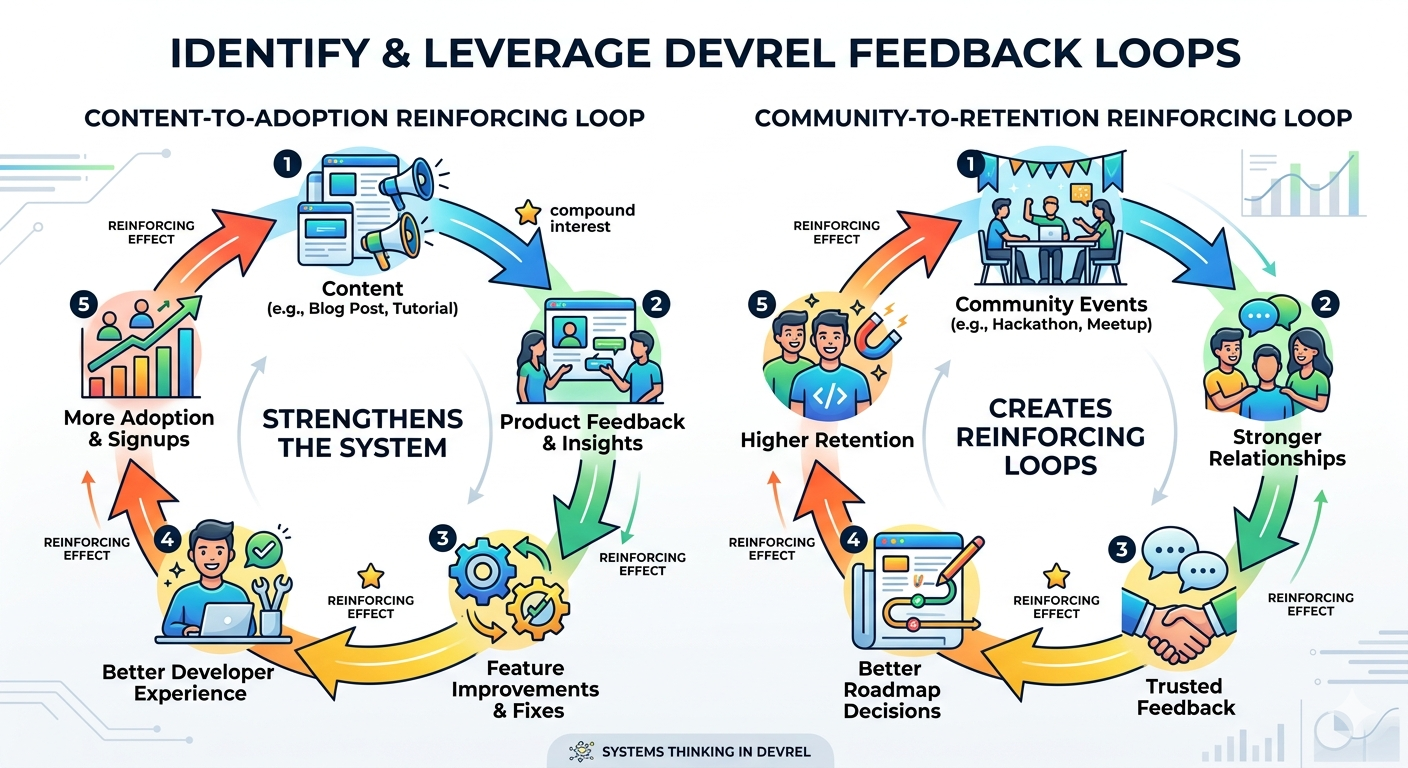
So, instead of asking "Did this blog post perform well? ask "What system did this blog post strengthen?" Strong DevRel systems compound over time because they create reinforcing loops.
Design for Leverage, Not Activity
Constant activities can sometimes feel like productive for most entry level DevRel. The problem with activity-based DevRel is that it has a shelf life of about 48 hours. If you stop moving, the impact stops growing. When you prioritize activity, you’re forced to reinvent the wheel for every new campaign or product launch.
One the other hand, when creating for leverage, you ensure that every hour of work fuels multiple outcomes. One well-designed system can produce ongoing results without constant reinvention.
So instead of hosting random webinars or publishing disconnected tutorials weekly, think in systems:
- Create cornerstone content that feeds multiple channels
- Turn webinars into blog posts, short-form clips, and newsletter insights
- Build documentation that reduces support load and improves onboarding simultaneously
Build Strategic Alignment
Strategic DevRel requires a tight feedback loop between what your company wants and what the developers need. That means you should be able to articulate DevRel efforts that transcend the product and tap into industry trends. By outlining the OKRs (Objectives and Key Results), you can evaluate how each DevRel experiment contributes directly to the larger architectural goal
Systems thinking forces alignment with business goals:
- If the company wants faster enterprise adoption, DevRel should support trust-building and technical validation
- If the goal is ecosystem expansion, DevRel should enable contributors and integrations
- If the priority is retention, DevRel should improve onboarding and documentation
When you understand the system, you stop creating content for content's sake. You design programs that influence key levers in the business.
Wrapping Up
The future of DevRel is not about being the person who knows the most tools. That knowledge is fleeting. The future belongs to the systems thinkers who can navigate the complex, interconnected web of product, community, and business.
By expanding your capacity for systems thinking, you move from being just another developer advocate to a strategic leader who can create lasting value for both your company and your developer community.