Top 5 DevRel Mistakes Every Beginner Developer Advocate Should Avoid
DevRel is often glamorized for the fancy conference talks, travel, public recognition, and social media visibility. This frequently masks the grit required to succeed in the space. For many people, that was their inspiration to delve into the space. Myself included. Three years ago, I made a pivotal decision to transition fully into developer relations.
My involvement in open-source communities and my contribution to cloud-native technologies made the transition feel natural. A few months in, I realized I wasn’t just going to consume these technologies anymore, but I had to explain them, simplify them, and help others navigate them in the projects themselves with ease.
Imagine my disappointment when I found out developer advocacy is more than just a public-facing job, but a career path that sits at the intersection of engineering, product, marketing, and community. Beneath these surface responsibilities are frequently overlooked expectations, such as in-depth technical expertise, strong communication skills, empathy, and long-term relationship-building.
This story is familiar to many people who are either new to developer advocates or the community or are considering a transition into the field. Whether you are a beginner or a senior engineer considering this pivot, here are the top five mistakes you must avoid to build a sustainable, high-impact career in DevRel.
1. The Generalist Trap
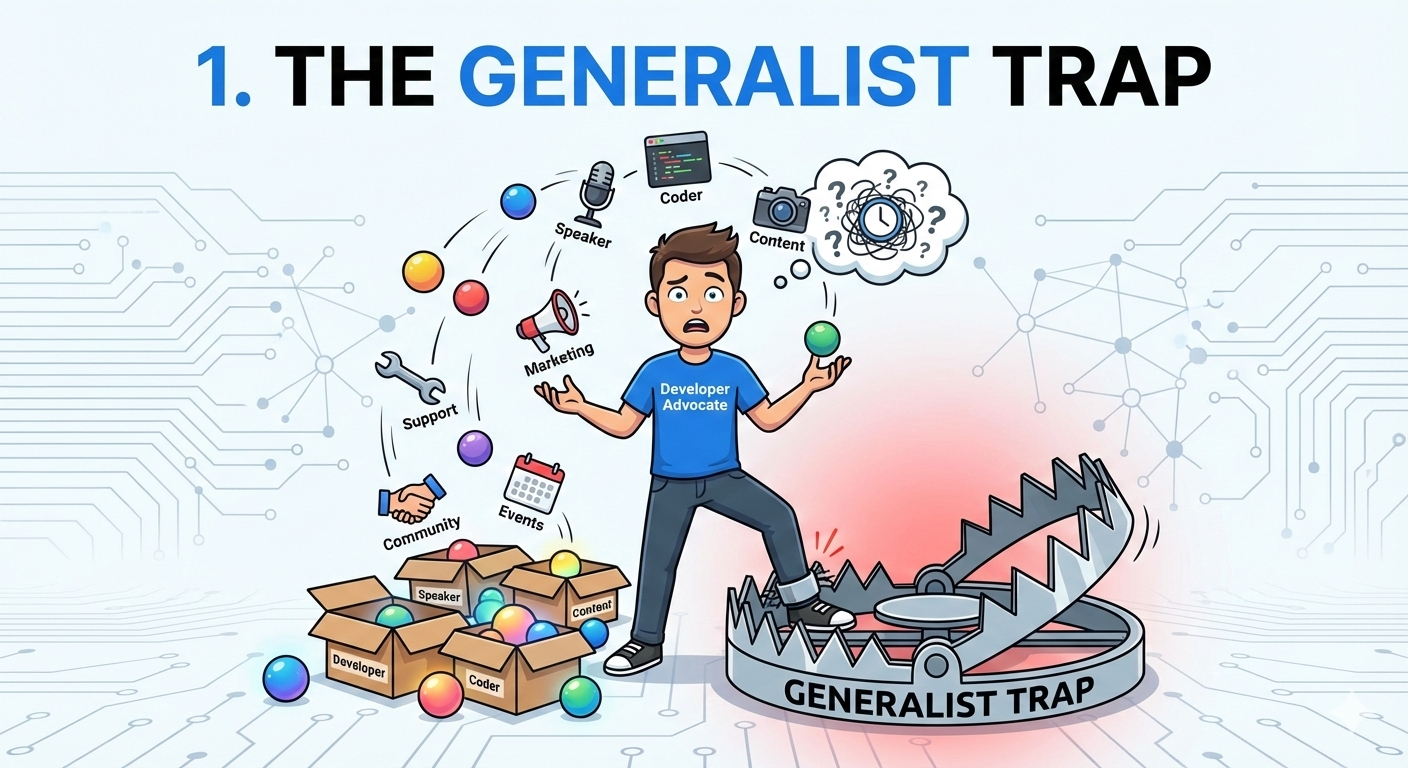
In the early stages of your DevRel career, it’s tempting to try to know everything about everything. Take, for instance, I have seen beginners spend a few months learning web development, then the next month focus on data analysis, and the following months they are focusing on either AI/ML, hardware development, Web3, cloud, or something completely different.
While trying to know a little bit about a lot may seem like versatility, it often makes it difficult to establish authority. Many practitioners mistake knowing a little about everything for growth, but in reality, this approach dilutes your cognitive resources and creates a cycle of fragmented learning, juggling one new topic and another. In DevRel, the fastest way to establish authority and build trust is to focus on broad awareness across adjacent domains (such as open source), while developing deep expertise in 1–2 areas where you can educate developers confidently, challenge assumptions, and influence technical decisions.
It's best to pick a niche. Whether it’s AI/ML, cloud-native infrastructure, hardware, or fintech, you need to be grounded in specific areas. Specialization makes you become a trusted voice in your chosen industry. You gain the ability to convince decision-makers and C-suite executives about the state of the industry because your knowledge isn't surface-level.
2. Lacking Technical Depth
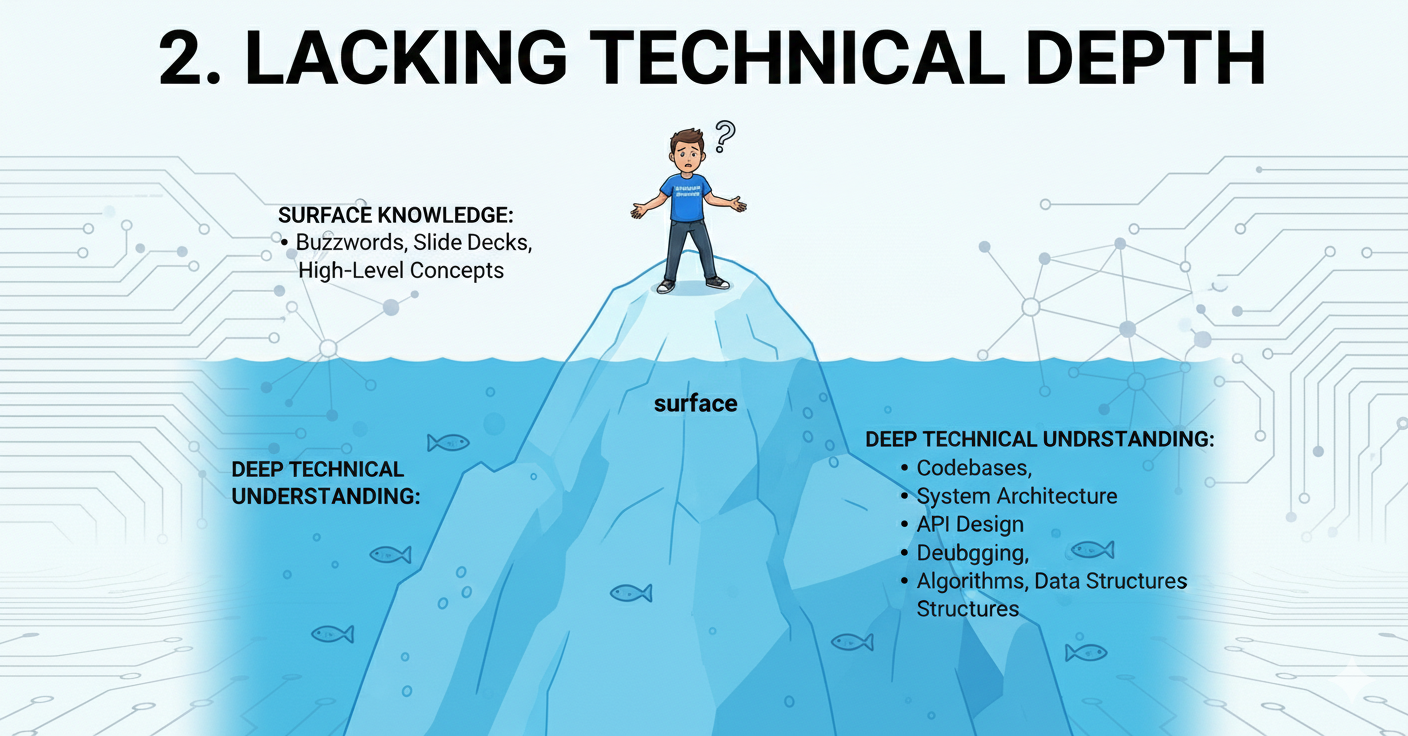
A common misconception is that DevRel is purely a "soft skills" role. Many believe that being a charismatic speaker or a compelling writer is enough.
While having strong communication is essential, developer relations (whether community management, technical writing, or developer advocacy) require extensive technical depth. To influence adoption and build credibility, you need to know why the project exists and how it works, what developers think, and how the product moves from problem to solution, not just enough to talk about it. Most DevRel leaders today transitioned from software development to developer advocacy. That engineering foundation gives them the knowledge to educate and engage with developers and product teams alike.
Without some level of understanding of the project or desired field, you are bound to experience a knowledge gap from time to time that often shows up in your performance in your role. It's like joining a conversation halfway through and needing to piece together what happened in the first half. Regardless of how long your articles are or how catchy your talk is, users and contributors are far more likely to trust you when you are able to:
- Provide solutions to the bugs users may be having
- Explain why a system behaved a certain way
- Reference architectural constraints, not just marketing promises
Take, for instance, you are making documentation updates. Adding hands-on debugging steps will reduce repeated community questions and free both maintainers and DevRel from reactive support, compared to documentation without one. It is critical that you have an in-depth understanding of the architectural decisions, know the trade-offs, and be able to help teams get from Point A to Point Z, reason with them, and educate both developers and users.
3. Overlooking the Strategic Art of Networking
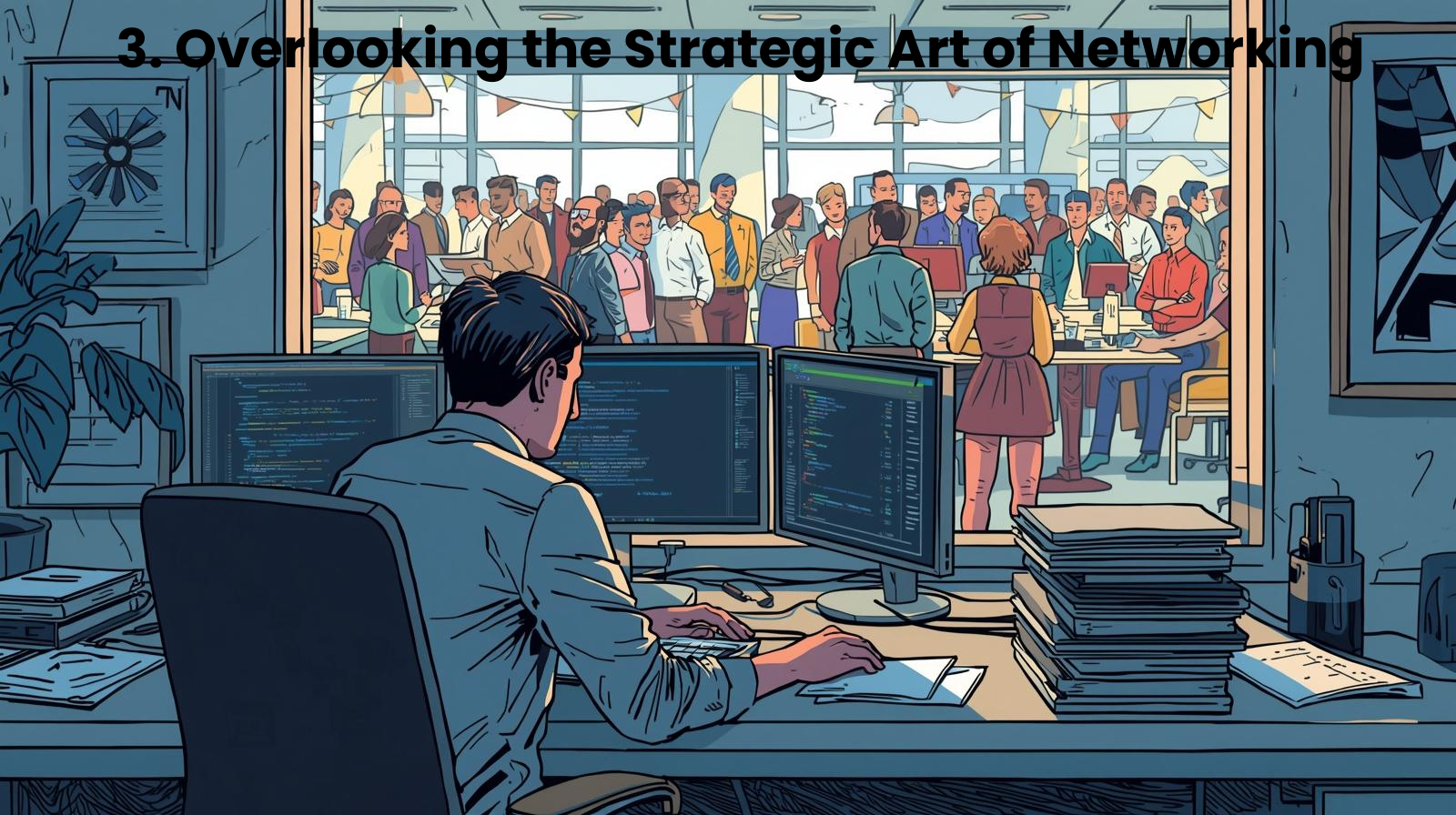
There is a common instinct to maintain a strictly transactional distance from colleagues, a "keep your head down and code" mentality. While this might feel safer, it is often a silent career-killer, especially in a relational career path like DevRel.
The people who have collaborated with you and your colleagues have seen your technical ability in real-time and experienced your reliability. They are often the ones who will advocate for you when opportunities are discussed and decisions are made. There is also a widely cited reality in business and technology that word-of-mouth drives adoption more effectively than most marketing strategies. Your ability to build genuine trust within your immediate network is the ultimate predictor of how much influence you will wield in the industry at large. That trust can become credibility in technical sales cycles. In most startups I’ve worked with, I have seen firsthand that a product’s adoption often hinges on the:
- Developers recommending the tool to other developers
- Community advocacy
- Trust built through consistent engagement
- OSS contributors advocating internally at their companies
In practical terms, this translates to shorter sales cycles, warmer enterprise conversations, and even faster community growth with no proportional increase in marketing spend for your team. That's why the community will always be your biggest advocates, and your internal team members can be your greatest allies. This is especially true in developer ecosystems.
4. Failing to Upskill and Unlearn
A common pitfall for most beginners getting into DevRel is becoming too comfortable with what they know and not wanting to upskill. Over the years, you will see that the tech ecosystem moves at a relentless pace. New frameworks, tools, and paradigms emerge weekly. So what worked two years ago may already be outdated.
Take for instance, 3 years ago, having an understanding or experience in DevOps and cloud-native tools like Kubernetes was critical for most high-paying DevRel jobs. Today, most DevRel job descriptions expect some level of expertise with AI/ML or LLMs to be considered a strong candidate for a role. If you rely solely on what you knew when you started, you will become obsolete within months.
As systems evolve, so do developer needs, workflows, and expectations. Your ability to adapt determines how long you remain relevant in the field. That means you should be committed to:
- Continuously upskilling
- Taking courses and certifications where relevant
- Building side projects with emerging tools.
- Staying curious rather than defensive
- Be willing to learn and unlearn old methodologies that no longer serve the current landscape.
DevRel teams that invest in continuous learning are often better positioned to understand developer pain points, influence product direction in its early stages, and produce content that stays relevant beyond launch cycles.

5. Ignoring the Feedback Loop
Another frequent trap that beginners in DevRel overlook is viewing the role as a one-way megaphone. You spend all your energy "advocating" to the developers but forget to advocate for them internally. I think if you aren't actively listening to the community, you aren't doing DevRel, you’re just doing marketing.
You should develop the habit of social listening, monitoring not just your own Slack or Discord channels but also other developer channels, Reddit, Stack Overflow, and even the comments section of competitor articles.
To provide real value to your product and engineering teams, you need to understand market sentiment. You should pay attention to:
- What are developers saying about alternative tools? Are they praising a competitor's CLI while complaining about yours?
- Lurking around in unmanaged spaces like Reddit or Twitter (X) often reveals the raw truths about your product’s friction points that users might be too polite to say in your official Slack.
- Observe the emerging pain points in your niche. Is the industry moving away from a specific architecture that your tool relies on?
Once you notice a pattern of frustration, you can quantify it and iterate back to your team.
For instance, "We’ve had 15 developers in the last week struggle with our Auth flow on Next.js. Here is a reproduction of the issue and a suggestion for a middleware update."

6. Ignoring Data and Business Impact
The fifth and perhaps most common mistake is not knowing how to document and report your impact as a DevRel to senior leadership. Visibility is often the most attractive part of DevRel. However, most people get carried away by vanity metrics like Twitter likes, article engagement, or talk attendance.
These metrics are public artifacts and visible layers to DevRel but do not necessarily communicate the business impact. Your leaders, your boss, your CFO, and even executives mostly care about impact; they speak of things like margin, risk, and pipelines. So when you keep measuring DevRel as if it's just a marketing channel, you are indirectly undermining the work and effort you put into your role. To truly position yourself as a DevRel leader, you must align your activities with business goals. That means, finding ways to tell the story of how the article, guides, demos, and conference presentations are:
- Reducing support tickets
- Increasing API sign-ups
- Shortening the "time to first Hello World" for new users
- Simplifying the developer roadmap

The Bottom Line
Developer Relations is a multi-faceted discipline that sits at the intersection of engineering, marketing, and product. It comprises several distinct layers: Developer Advocacy, Community Management, Technical Content & Writing, and Developer Experience (DX). As a result, to succeed and build a long-term career in this space, you should be able to blend your technical expertise, communication, empathy, and long-term relationship building skills.